Molt
Toolpath generation for large format thermoplastic printing on a robot arm, built one component at a time.

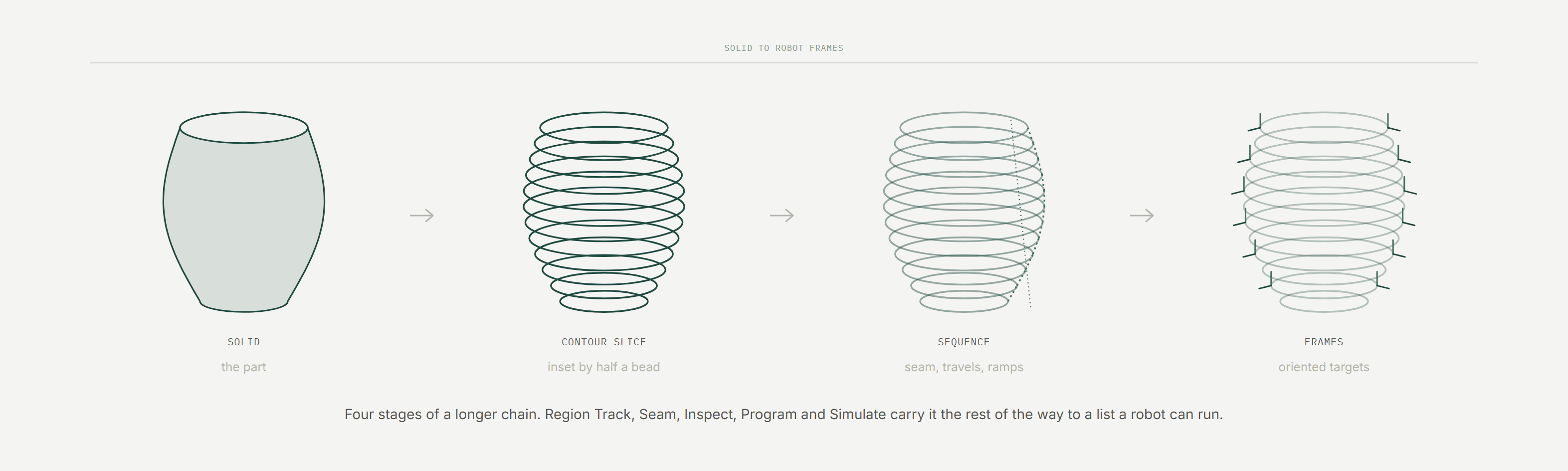
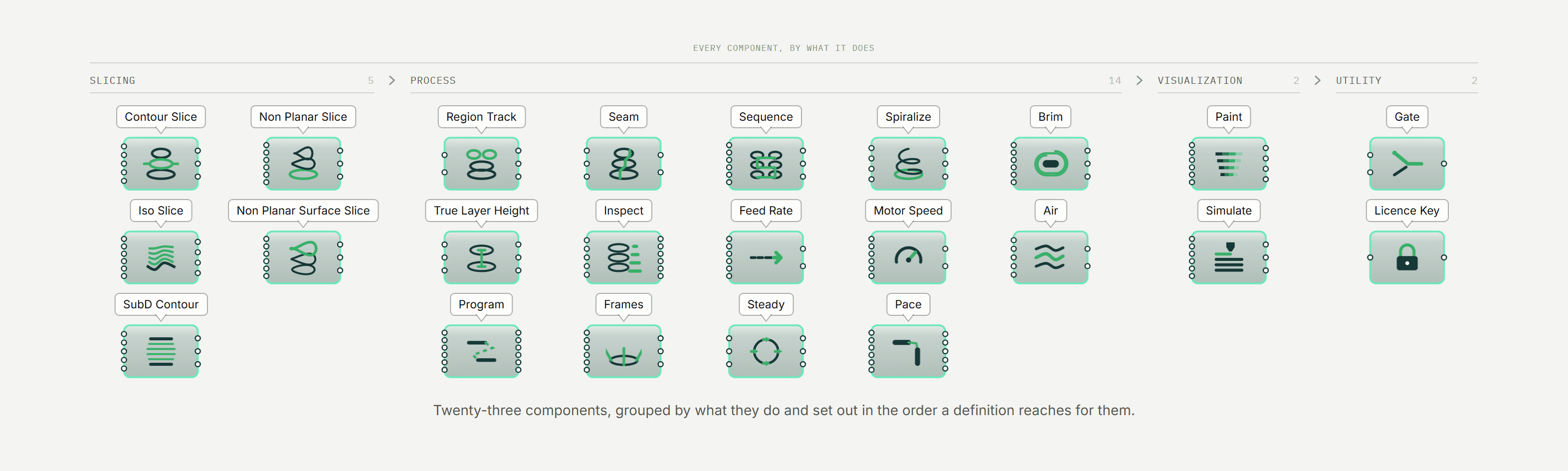
Molt turns a solid into a path a robot arm can print. A slice becomes contours inset by half a bead, regions are tracked as they split and merge on the way up, a seam is placed deliberately rather than wherever the curve happens to start, layers are sequenced with their travels and ramps, and the result leaves as oriented frames. It is aimed at an ABB IRB 4600 carrying a pellet extruder: ten pounds an hour through a nozzle up to six millimetres, with no retraction, which is a different problem from desktop printing at almost every step.
Not every layer has to be flat. One slicer displaces each flat section along the build normal to follow a driving surface, which is how the stair stepping under a shallow dome disappears. Another walks up a surface instead of cutting through it, for a single wall print where the surface already is the toolpath. Both routes feed the same components downstream.
It does not stop at the path. Program stitches the printed moves and the crossings between them into one list, because a robot runs one list and every target on it needs a speed and an extruder command, including the ones where the answer is none: on an extruder that cannot retract, the motor reaching zero on a crossing is the difference between a string across the part and a clean hop. Simulate then runs that program and builds the bead as it goes, at the width and height the flow was computed against, and Inspect colours a path by how printable it is long before any of it reaches a machine.